
Choosing the Right Development Model for Your Certification Program
When organizations launch or modernize a certification program, one of the first operational decisions is determining how assessment development will work. Should your internal team build and manage the entire…
TrueAbility
TrueAbility
When organizations launch or modernize a certification program, one of the first operational decisions is determining how assessment development will work.
Should your internal team build and manage the entire assessment experience?
Should you collaborate with a platform provider on delivery infrastructure and grading workflows?
Or do you need additional implementation support to accelerate launch?
In performance-based testing, the answer is rarely just about content.
Reliable assessment delivery also requires:
- Environment provisioning
- Automated grading
- Deployment orchestration
- Candidate workflow management
- Validation and testing
- Infrastructure scalability
The right model depends on your internal resources, technical expertise, timelines, and long-term certification strategy.
Most organizations fall into one of three delivery models:
- Customer-Built (Self-Service)
- Collaborative Development
- Additional Implementation Support
Each model offers different levels of ownership, flexibility, and operational involvement.
The Three Assessment Development Models
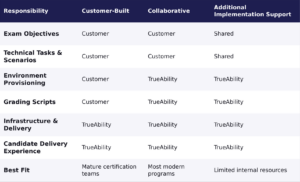
1. Customer-Built (Self-Service)
In the customer-built model, the organization owns and builds the assessment experience internally.
TrueAbility provides the infrastructure, deployment framework, and delivery platform, while the customer manages the technical implementation itself.
The customer is responsible for:
- Exam objectives
- Scenario creation
- Environment configuration
- Provisioning workflows
- Grading logic
- Validation requirements
- Ongoing maintenance
TrueAbility provides:
- Scalable delivery infrastructure
- Environment orchestration tooling
- Candidate delivery workflows
- Platform management
- Operational reliability
This model is best suited for organizations with:
- Dedicated certification engineering resources
- Internal DevOps capabilities
- Mature assessment programs
- Existing content development processes
- A preference for maximum ownership and control
For these organizations, TrueAbility acts as the infrastructure layer powering scalable delivery.
Best Fit For:
- Mature certification ecosystems
- Organizations with internal technical assessment teams
- Programs requiring maximum implementation control
2. Collaborative Development
Collaborative development is the model most organizations choose.
In this approach, the customer owns the subject matter expertise while TrueAbility helps operationalize the assessment into a scalable, reliable delivery experience.
The customer provides:
- Exam objectives
- Technical workflows
- Desired candidate outcomes
- Product expertise
- Subject matter expertise
TrueAbility helps with:
- Environment provisioning
- Grading workflows and automation
- Deployment orchestration
- Environment consistency
- Candidate workflow reliability
- Validation and testing
- Scalable delivery infrastructure
This model creates a clear separation of responsibilities:
The customer defines what should be tested.
TrueAbility helps operationalize how the assessment is delivered and validated at scale.
For many organizations, this creates the best balance between
- Content ownership
- Speed to launch
- Scalability
- Reliability
- Reduced operational overhead
Instead of building and maintaining assessment infrastructure internally, certification teams can focus on:
- Technical accuracy
- Certification strategy
- Product alignment
- Candidate experience
- Program growth
Meanwhile, TrueAbility manages the operational complexity behind the scenes.
Why Many Organizations Prefer Collaborative Development
Performance-based assessments introduce infrastructure challenges that traditional multiple-choice exams do not.
Organizations must manage:
- Live environments
- Repeatable deployments
- Automated scoring
- Environment isolation
- Consistent candidate experiences
- Global scalability
Collaborative development allows organizations to leverage their internal expertise without needing to build an assessment delivery framework from scratch.
For many modern certification programs, this becomes the fastest and most sustainable path to launch.
Best Fit For:
- Organizations with strong SMEs but limited assessment engineering resources
- Certification teams prioritizing speed and scalability
- Programs transitioning from MCQ to performance-based testing
- Organizations seeking operational reliability without sacrificing content ownership
3. Additional Implementation Support
Some organizations need additional assistance accelerating a program launch or implementing technical assessment workflows.
In these cases, TrueAbility can provide additional implementation support around:
- Environment creation
- Scenario implementation
- Grading workflows
- Deployment configuration
- Technical validation
- Candidate experience optimization
This model is typically used when:
- Internal resources are limited
- Teams are new to performance-based assessments
- Launch timelines are aggressive
- Additional operational support is needed temporarily
Even in these engagements, organizations typically remain closely involved in defining the technical objectives and desired candidate outcomes.
The goal is not replacing internal expertise.
The goal is helping operationalize reliable assessment delivery more efficiently.
Best Fit For:
- Smaller certification teams
- Organizations launching their first performance-based assessment
- Programs with limited implementation bandwidth
- Teams needing accelerated deployment support
The Infrastructure Side Most Teams Underestimate
One of the biggest misconceptions in performance-based testing is that assessment development is primarily about content.
In reality, infrastructure reliability is equally important.
Even technically accurate assessments fail if:
- Environments deploy inconsistently
- Labs break during delivery
- Scoring behaves unpredictably
- Provisioning delays impact candidates
- Support overhead becomes unsustainable
As certification programs scale globally, operational maturity becomes increasingly critical.
Modern performance-based assessment platforms must support:
- Reliable environment provisioning
- Automated validation
- Repeatable grading workflows
- Environment isolation
- Secure delivery
- High availability
- Global candidate access
This operational layer is where many organizations benefit from collaborative assessment models.
How TrueAbility Supports Scalable Assessment Delivery
TrueAbility was designed to support flexible operational models.
Some organizations want complete ownership over assessment implementation.
Others prefer a collaborative workflow that combines internal subject matter expertise with external infrastructure expertise.
To support both approaches, TrueAbility has invested heavily in its next-generation deployment framework.
This delivery framework uses Ansible-based workflows to streamline:
- Environment provisioning
- Grading automation
- Validation workflows
- Repeatable deployment
- Scalable candidate delivery
This helps organizations launch and manage performance-based assessments with:
- Faster provisioning
- More consistent candidate experiences
- Improved reliability
- Reduced operational overhead
- Scalable global delivery
Questions to Ask Before Choosing a Model
Before selecting an assessment development model, organizations should evaluate:
Do We Have Internal Technical Resources?
Customer-built models require internal engineering and assessment implementation capabilities.
How Quickly Do We Need to Launch?
Collaborative workflows often reduce launch timelines significantly.
Do We Want to Maintain Provisioning and Grading Internally?
Some organizations prefer full ownership. Others prefer operational support.
How Frequently Will Content Change?
Rapidly evolving technical products may require flexible workflows and faster deployment cycles.
What Scale Are We Expecting?
Global certification programs introduce significantly different operational requirements than pilot programs.
The Future of Certification Programs Is Flexible
There is no single “correct” operational model for performance-based assessments.
Some organizations prefer full ownership.
Some prioritize collaborative scalability.
Others need additional implementation support to accelerate deployment.
What matters most is choosing a model that aligns with:
- Internal team structure
- Technical capabilities
- Launch timelines
- Scalability goals
- Long-term certification strategy
Organizations already know what skills they want candidates to demonstrate.
TrueAbility helps operationalize reliable, scalable assessment delivery around those goals.
Final Thoughts
Choosing between customer-built, collaborative, or implementation-supported assessment development is not simply a build-versus-buy decision.
It is an operational strategy decision.
The most successful certification programs typically combine:
- Strong internal subject matter expertise
- Reliable assessment infrastructure
- Scalable operational workflows
- Consistent candidate experiences
As performance-based testing continues to grow, organizations increasingly need assessment platforms capable of supporting both technical accuracy and operational reliability at scale.
Whether your team wants to:
- Build assessments internally
- Collaborate on operational delivery
- Or accelerate implementation with additional support
TrueAbility provides flexible models designed around modern certification programs and scalable performance-based assessment delivery.