
How to Design Performance-Based Questions for a Performance Exam
Performance-based questions for certifications & on-the-job exams can be complex to design. Follow these tips & techniques for optimized staff hiring.
TrueAbility
TrueAbility

If you’re asking what are performance-based questions, and how they apply to a performance exam, you’re asking the right question. Moving from multiple-choice to performance-based design isn’t a technical problem. It’s a design problem. And it’s more familiar than most certification managers expect.
What Are Performance-Based Questions?
Performance-based questions are designed to assess how someone performs in real-world situations—not what they can recall on demand.
In interviews, they ask candidates to draw on past experience to demonstrate problem-solving, critical thinking, and technical ability. In exams and certifications, they go a step further: candidates must apply knowledge to simulated scenarios that haven’t happened yet, inside environments that reflect the actual job.
Both formats share the same underlying logic. The goal isn’t to catch candidates out. It’s to surface demonstrated capability rather than theoretical knowledge.
Who Is This For?
Performance-based questions are relevant for anyone responsible for evaluating people—whether that’s a hiring manager designing interview questions, a certification manager building a technical exam, or an L&D team assessing whether training has actually stuck.
The stakes are highest in technical roles where on-the-job performance is difficult to predict from a conversation alone. But the principles apply broadly. Any role where judgment, problem-solving, or applied skill matters is a candidate for performance-based evaluation.
Performance-Based Questions in Interviews
Traditional interview questions test what someone knows or thinks. Performance-based interview questions test what someone has done, and by extension, what they’re likely to do.
The most effective format combines three dimensions in a single question: competency, behavior, and performance. A question like “Describe a time you had to dismiss a team member — how did you approach it and why?” tells a hiring manager about the candidate’s judgment, their process, and their reasoning all at once.
This structure naturally produces STAR-method responses: Situation, Task, Action, Result — without having to prompt for them. That makes evaluation faster and more consistent across candidates.
Examples of performance-based interview questions:
- Describe a situation where you had to solve a time-sensitive problem while managing competing priorities. What did you do and how did it turn out?
- Walk me through the most complex technical challenge you’ve owned end-to-end. What was your approach and what would you do differently today?
- Tell me about a time you had to deliver difficult feedback to a peer. How did you handle it and what was the outcome?
- Describe a situation where you disagreed with a technical decision your team made. What did you do?
Examples of performance-based questions for employee reviews:
- Which organizational goals have you directly contributed to this year, and how did you contribute?
- What have you done in the past year to develop your skills, and how has that made you more effective in your role?
- Where did you fall short of your own expectations this year, and what did you learn from it?
The common thread across all of these: they ask for specific examples, not hypotheticals. “What would you do if…” is not a performance-based question. “Tell me about a time when…” is.
Performance-Based Questions in Exams and Certifications
A performance exam works differently from a performance-based interview — and that distinction matters for designers.
In an interview, you’re asking candidates to reflect on past experience. In a performance exam, you’re asking them to apply current knowledge inside a simulated environment. There’s no “describe a time when” — there’s only the task in front of them and the tools they’ve been given.
That shift changes what subject matter experts need to produce. Instead of asking “what questions should we ask?”, they need to ask:
- What tasks do we want the candidate to complete?
- What does a successful outcome look like for each task?
- What tools, software, and context will the candidate have access to?
- What does partial success look like — and how should it be scored?
This requires experts to mentally walk through sequential actions that lead to specific, verifiable outcomes, and to design tasks that surface problem-solving, technical skill, and decision-making in ways that multiple-choice questions simply can’t.
The environment matters as much as the question. A performance exam that asks candidates to troubleshoot a server issue needs to provide a server, not a description of one.
What’s Similar to MCQ — and What Isn’t
The process of designing a performance exam shares more with MCQ development than most people expect.
Both require a job task analysis, both benefit from experienced psychometricians to ensure validity and defensibility, and both depend on subject matter experts for item development, typically drawn from engineering, sales, and customer support.
The divergence happens when those experts sit down to write items.
In MCQ development, the focus is on knowledge: what should candidates know, what are the valid distractors, how do you avoid giving away answers? In performance exam development, the focus shifts to application: what should candidates be able to do, what does correct execution look like, and how do you design a simulated environment that makes that visible?
This shift toward application aligns with international testing guidance, which emphasizes that assessments should reflect how skills are actually used in practice—not just whether they can be recalled.
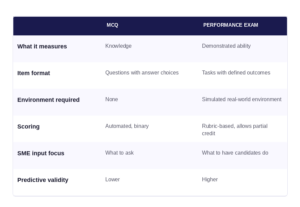
Subject matter experts who make this shift well tend to find it more satisfying, because they’re drawing directly on their actual job experience rather than constructing abstractions. The key is engaging them early and grounding them with examples before item writing begins.
How to Design Performance-Based Questions for a Certification Exam
Step 1: Start with a job task analysis.
Identify what candidates must be able to do in the role, not just what they need to know. Every exam task should map to a real job behavior. This approach aligns with widely accepted testing standards, which emphasize that assessments must be grounded in real-world job tasks and validated against the behaviors they are intended to measure.
Step 2: Define outcomes before writing tasks.
For each task, define what successful completion looks like before you write the task itself. This prevents tasks from being designed around what’s easy to measure rather than what actually matters.
Step 3: Engage subject matter experts early.
SME input isn’t a review step. It’s a design input. Bring experts in before item writing begins, ground them in the performance-based format with examples, and give them a clear framework for thinking about tasks, outcomes, and scoring.
Step 4: Build the scoring rubric alongside the task.
Unlike MCQ, performance exams require decisions about partial credit, alternative solution paths, and edge cases. A rubric built after the fact creates inconsistency. Build it while the task is being designed.
Step 5: Validate every task against real job behavior. Before the exam goes live, verify that every task reflects something candidates will actually encounter on the job. Tasks that don’t map to real work don’t belong in the exam; regardless of how well-designed they are.
Step 6: Plan for ongoing maintenance.
Performance exams require more maintenance than MCQ—because the environments, tools, and job tasks they reflect evolve over time. Build a review cycle into your program from the start.
Where Performance Exam Design Goes Wrong
Even experienced teams run into the same problems.
Underestimating the environment requirement. A performance exam isn’t just a different question format. It requires a simulated environment that reflects real tools, real constraints, and real conditions. Without that, the assessment loses fidelity and candidates are evaluated on their ability to work in an unfamiliar environment rather than on the skills you’re trying to measure.
Bringing in subject matter experts too late. SME input isn’t a final review step. It’s a foundational design input. Teams that treat it as a formality produce assessments that don’t reflect the actual job. The earlier experts are engaged, the better the exam.
Skipping task validation. Every performance-based task needs to be verified against real job behavior. If the task doesn’t map to something candidates will actually do on the job, it doesn’t belong in the exam, and including it undermines the validity of the whole assessment.
No scoring rubric for partial success. Unlike MCQ, performance exams require decisions about partial credit, alternative solution paths, and edge cases. Building that rubric after the fact creates inconsistency across candidates and makes the exam harder to defend.
Treating it as a one-time project. Performance exams require ongoing maintenance. Tools change, job tasks evolve, and candidates surface alternative solution paths that designers didn’t anticipate. Without a review cycle, the exam drifts out of alignment with the job it’s supposed to measure.
What’s Changed in 2026
AI has complicated task design — in a useful way. As AI tools become standard in technical roles, performance exam designers have to decide whether candidates should have access to them during assessment. Increasingly, the answer is yes, and that requires rethinking what “correct execution” looks like when AI assistance is in the picture. The question is no longer “can they do it?” but “can they do it well, with the tools they’ll actually have?”
Remote delivery has removed the last logistical barriers. Cloud-based environments that emulate real workstations make it possible to deliver a high-fidelity performance exam globally without on-site infrastructure. The scale problem is largely solved—what remains is the design problem.
Skills-based hiring has expanded the audience. As organizations move away from degree requirements, performance-based questions, both in interviews and exams, have become the primary evaluation tool for a much wider range of roles. Design quality matters more than ever, because these assessments are now carrying more weight in hiring decisions.
Candidates expect better assessments. High-quality candidates increasingly push back on poorly designed evaluations. A performance exam that feels disconnected from real work damages your employer brand. One that feels realistic and fair builds confidence—in your program and in your organization.
The Bottom Line
Performance-based questions work in interviews and in exams, because they measure what candidates can actually do, not just what they know.
Designing them well requires the right subject matter experts, the right environment, and a clear picture of what successful performance looks like in each specific role. That’s not a small lift—but it’s not a reinvention either. The foundations are the same as MCQ. The mindset is what has to shift.
TrueAbility partners with organizations to build and deliver performance exams at scale—handling environment emulation, exam operations, and ongoing maintenance so certification managers can focus on program growth.
Ready to see what it looks like in practice?
Frequently Asked Questions
What are performance-based questions?
Performance-based questions assess how someone performs in real-world situations rather than what they can recall on demand. In interviews, they ask candidates to draw on past experience to demonstrate relevant skills and behaviors. In exams, they require candidates to complete real tasks inside simulated environments that reflect actual job conditions.
What is a performance exam?
A performance exam is an assessment that requires candidates to complete real-world tasks inside a simulated environment rather than answering questions about what they would do. It measures demonstrated ability, not theoretical knowledge, and is scored against predefined outcomes tied to actual job performance.
How is a performance exam different from a multiple-choice exam?
A multiple-choice exam tests what someone knows. A performance exam tests what they can do with that knowledge under realistic conditions. The design process is similar; both require job task analysis and subject matter expert input—but a performance exam also requires a simulated environment and task-based scoring criteria.
What are examples of performance-based interview questions?
Examples include: “Describe a situation where you had to solve a time-sensitive problem while managing competing priorities — what did you do and how did it turn out?” and “Walk me through the most complex technical challenge you’ve owned end-to-end.” The best performance-based questions surface competency, behavior, and reasoning in a single prompt.
How do you design performance-based questions for certification exams?
Start with a job task analysis to identify what candidates must be able to do. Engage subject matter experts early to define tasks, expected outcomes, and the tools candidates will have access to. Build a scoring rubric that accounts for partial success and alternative solution paths. Then validate every task against real job behavior before the exam goes live.
What is the difference between a performance-based question and a behavioral interview question?
The terms are often used interchangeably, and the overlap is significant. Both ask candidates to reference past experience rather than describe hypothetical responses. The distinction is one of emphasis: behavioral questions focus on past behavior as a predictor of future behavior, while performance-based questions emphasize the specific competencies and outcomes demonstrated in that behavior.
How do AI tools affect performance exam design?
As AI tools become standard in technical roles, exam designers need to decide whether candidates should have access to them during assessment. In most cases, the answer is yes—because that’s how the work is actually done. That requires rethinking task design and scoring criteria to evaluate how well candidates use AI assistance, not just whether they can complete tasks without it.
How long does it take to design a performance exam?
It depends on the complexity of the role and the number of tasks involved. A well-designed performance exam for a single technical role typically requires several months of development—including job task analysis, SME engagement, environment setup, task validation, and rubric development. Partnering with an experienced platform provider can significantly reduce that timeline.
AbilityScreen is a registered trademark of TrueAbility in the United States and other countries. All other trademarks, trade names or service marks used or mentioned herein belong to their respective owners.