
TrueAbility vs. HackerRank: What's the Difference Between Solving Problems and Performing Real Work?
Organizations today have more options than ever when it comes to technical skills assessment. HackerRank and TrueAbility are both powerful platforms, but they’re designed to answer different questions. HackerRank helps…
TrueAbility
TrueAbility
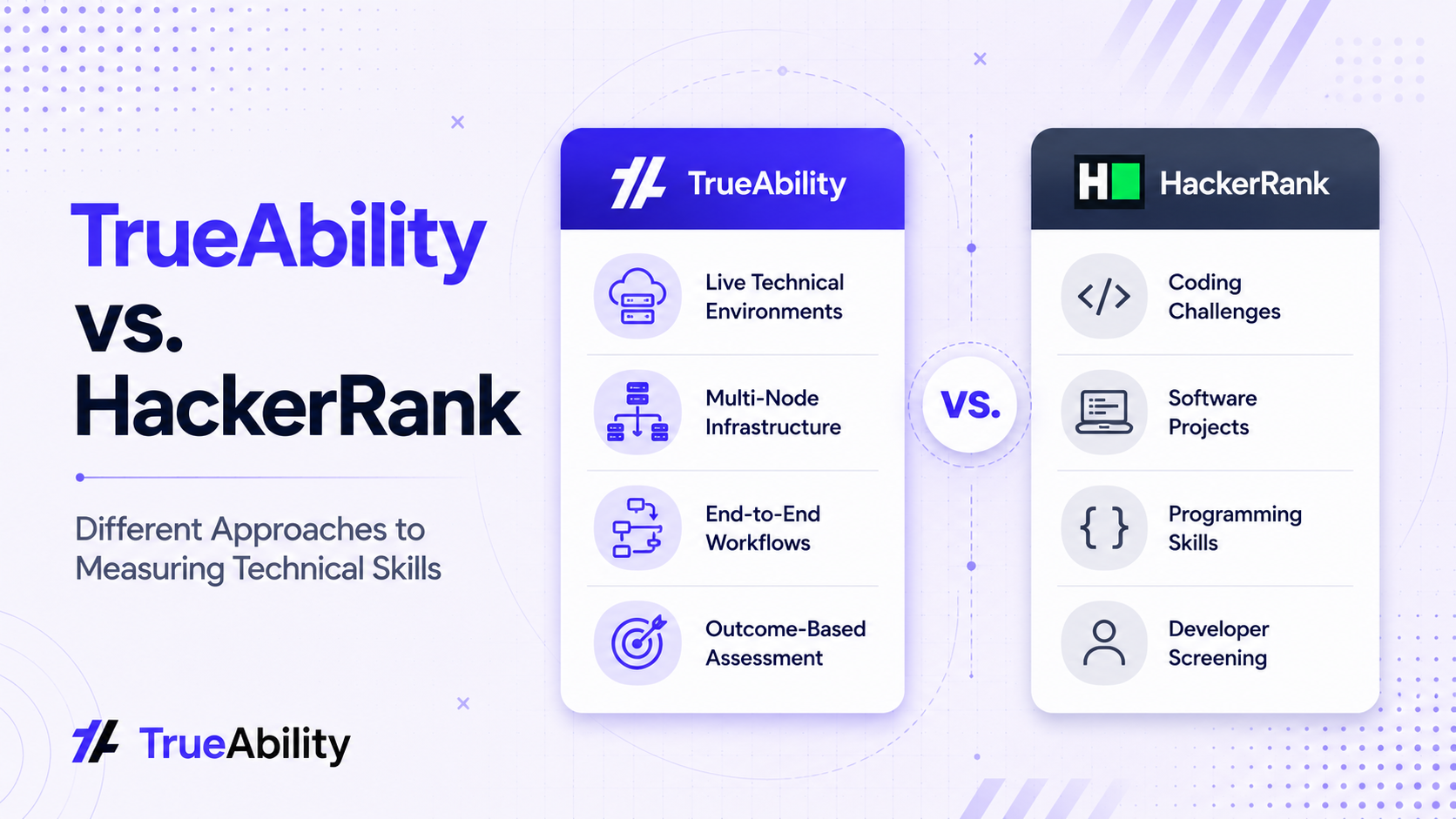
Organizations today have more options than ever when it comes to technical skills assessment. HackerRank and TrueAbility are both powerful platforms, but they’re designed to answer different questions.
HackerRank helps organizations evaluate programming ability through coding challenges, software development projects, and hands-on DevOps exercises. TrueAbility measures whether candidates can perform real-world technical work by completing practical tasks in live cloud and virtualized environments.
Both platforms help organizations identify technical talent. The difference lies in what they’re measuring.
As technical roles become more complex—and AI tools become more capable—the question is no longer simply:
Can this person solve a programming problem?
Increasingly, organizations need to know:
Can this person successfully perform the work they’ll actually be asked to do?
That distinction has become especially important for roles in cloud infrastructure, DevOps, cybersecurity, IT operations, and certification programs, where success depends on executing tasks across real systems—not just knowing the right answer.
What HackerRank Measures
HackerRank excels at evaluating software engineering fundamentals.
Depending on the assessment, candidates may:
- Solve programming challenges
- Complete multi-file coding projects
- Work within persistent Linux-based DevOps environments
- Demonstrate language proficiency
- Optimize code for correctness and performance
For organizations hiring software developers, HackerRank provides valuable insight into how candidates think through technical problems and implement solutions.
What TrueAbility Measures
TrueAbility is purpose-built for performance-based assessment.
Rather than focusing primarily on coding proficiency, TrueAbility places candidates inside live, production-like environments where they complete the kinds of technical tasks they’ll perform on the job.
Depending on the role, candidates may:
- Configure cloud infrastructure
- Troubleshoot production issues
- Manage Kubernetes clusters
- Administer Linux or Windows systems
- Configure networking services
- Deploy applications
- Analyze logs and monitoring data
- Complete multi-step operational workflows
The objective isn’t simply determining whether someone knows the answer.
It’s measuring whether they can successfully achieve the expected outcome in a live environment.
Beyond a Single Environment
Many technical assessment platforms now offer hands-on environments. HackerRank, for example, provides persistent Linux sandboxes for DevOps exercises and temporary AWS accounts where candidates complete individual cloud tasks in a real console.
TrueAbility extends that concept in a fundamental way: instead of a single machine or a single cloud account scoped to one task, TrueAbility provisions complete infrastructure that mirrors real-world operational environments.
A single assessment can include:
- Multiple networked virtual machines that communicate with one another
- Full Linux and Windows desktop environments—not just browser-based terminals
- Custom networking policies and isolated environments
- Controlled internet access when required
- Automated scoring based on the final state of the environment
Instead of evaluating tasks in isolation, organizations can assess how candidates troubleshoot, configure, and manage systems that behave like real production infrastructure.
The Difference Between Knowledge and Performance
Consider a cloud administrator position.
A knowledge-based assessment might ask:
Which command would you use to view running containers?
A development-focused assessment might ask:
Write a script that interacts with containerized workloads.
A performance-based assessment asks:
Here’s a live environment with multiple systems. A service is failing. Diagnose the issue, restore functionality, verify the fix, and leave the environment in the expected state.
Those measure fundamentally different capabilities.
One measures knowledge.
The other measures execution.
Why This Matters More in the Age of AI
AI assistants can now generate code, explain concepts, troubleshoot syntax, and answer technical questions in seconds.
As a result, organizations are placing increasing value on what candidates can accomplish—not simply what they can recall.
Execution still requires:
- Context awareness
- Troubleshooting
- Decision making
- Understanding dependencies between systems
- Validating outcomes
- Adapting when the first solution doesn’t work
These are the skills that determine success in production environments, and they’re often difficult to evaluate through traditional testing methods alone.
Built for Performance-Based Certification
Performance-based hiring assessments are only one use case.
Certification programs often require additional capabilities around security, repeatability, and scale. TrueAbility was designed with those requirements in mind.
Key capabilities include:
- Multi-node assessment environments that provision two or more connected virtual machines for realistic scenarios.
- Full desktop access to Linux and Windows environments, allowing candidates to work with graphical interfaces as well as command-line tools.
- Environment isolation and networking controls using configurable networking policies and controlled internet access.
- Comprehensive session recording that captures the full desktop and terminal experience across all assessment nodes, supporting review and auditability alongside integrated identity verification and proctoring.
- Snapshot and restore capabilities for repeatable assessments and consistent grading.
- Automated scoring with partial credit based on the final state of the live environment.
- Environment pools and assessment variants that enable secure, scalable delivery for high-volume certification programs.
These capabilities allow certification providers to evaluate practical skills while maintaining consistency, fairness, and exam integrity at scale.
Hiring the Person, Not Just the Resume
Many candidates can explain how a system works.
Fewer can demonstrate that they can successfully operate that system under realistic conditions.
Performance-based assessments help close that gap.
Rather than relying solely on interviews, resumes, certifications, or coding challenges, organizations can observe candidates performing the actual work associated with the role.
The result is a more objective, job-relevant measurement of capability.
Different Tools for Different Questions
HackerRank and TrueAbility aren’t mutually exclusive. In many organizations, they complement one another.
If your goal is to evaluate programming ability, software engineering fundamentals, and coding proficiency, HackerRank provides a mature and effective platform.
If your goal is to determine whether someone can troubleshoot infrastructure, administer systems, deploy applications, or complete complex operational workflows across multiple connected systems, TrueAbility provides a different type of assessment.
Many hiring teams and certification programs increasingly use both approaches: coding assessments to measure software development skills, and performance-based assessments to validate real-world execution.
Because in today’s AI-assisted world, knowing the answer and successfully doing the work are no longer the same thing.
Ready to see performance-based assessment in action? Schedule a personalized introduction.