
How to Convert an MCQ Exam to a Performance-Based Assessment
If you’re asking how to convert an MCQ exam to a performance-based test, you’re asking the right question. The gap between what multiple-choice exams measure and what employers actually need…
TrueAbility
TrueAbility
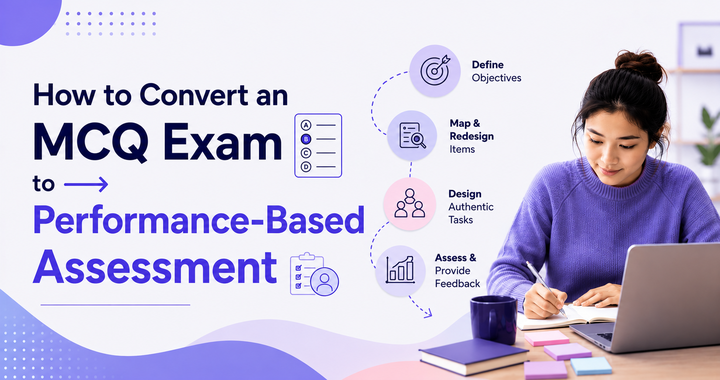
If you’re asking how to convert an MCQ exam to a performance-based test, you’re asking the right question. The gap between what multiple-choice exams measure and what employers actually need from certified professionals has never been more obvious or more expensive. This guide covers what the conversion actually involves, how to approach it step by step, and where most programs go wrong.
What Does It Mean to Convert an MCQ Exam to a Performance-Based Test?
Converting an MCQ exam to a performance-based assessment means replacing questions that ask candidates to recognize correct answers, with tasks that require them to produce correct outcomes in environments that reflect the actual job.
A multiple-choice question can tell you that a candidate knows what command changes file permissions in Linux. A performance-based task can tell you whether they can actually apply the right permissions under realistic conditions, without prompting, and without a list of options to choose from.
Knowledge and performance are not the same thing. Candidates can pass MCQ exams and still fail on the job. Research consistently shows that performance-based assessments have higher predictive validity for on-the-job success than knowledge-based tests. In other words, candidates who pass are more likely to succeed on the job because they have already demonstrated the skills required.
For organizations running high-stakes technical certifications, the credibility gap is particularly acute. When certified candidates can’t perform the work the credential claims they can do, employers stop treating the certification as a hiring signal. Rebuilding that trust requires the assessment to verify ability, not just knowledge.
Who Is This For?
This guide is for certification program managers, exam developers, and L&D professionals who are evaluating or actively planning a migration from multiple-choice to performance-based testing. It’s also relevant for HR and talent teams using MCQ-based screening assessments who are seeing weak predictive validity on the job.
Technical roles such as cloud infrastructure, cybersecurity, systems administration, and software development are some of the clearest examples of where knowledge tests fall short. In these fields, employers need to know whether candidates can actually perform the work. The same idea applies to any role that depends on applied skill and decision-making in realistic situations.
If your credential claims that certified professionals can do something — configure a system, secure a network, deploy an application, but your exam only tests whether they can describe how, this guide is for you.
What Stays the Same and What Doesn’t
The conversion from MCQ to performance-based testing shares more with existing exam development practice than most people expect.
Both require a job task analysis. Both benefit from experienced psychometricians to ensure validity and defensibility. Both depend on subject matter experts for item development. The process foundations are the same.
The real difference starts when subject matter experts begin designing assessment tasks.
In MCQ development, the focus is on knowledge: what should candidates know, what are the valid distractors, how do you write options that don’t inadvertently signal the correct answer. In performance-based development, the focus shifts entirely to application: what should candidates be able to do, what does correct execution look like, and how do you design an environment that makes demonstrated ability visible.
The biggest shift is moving from “what should we ask?” to “what should candidates actually do?” That mindset change is what drives the entire conversion process. Everything else follows from it. This principle is consistent with widely accepted testing standards, including guidance from the Standards for Educational and Psychological Testing (AERA, APA, NCME), which holds that assessments must be grounded in real-world job tasks and validated against the behaviors they are intended to measure.
How to Identify Which MCQs to Convert
Not every multiple-choice question needs to become a performance task. The first step is separating the ones that should from the ones that shouldn’t.
Pull your existing question bank and tag each item by the competency it claims to measure. Then classify those competencies into two categories: foundational knowledge and applied skill.
Foundational knowledge items such as definitions, concepts, and underlying theory may be worth retaining, particularly as prerequisite screening or as a knowledge gate before performance tasks begin. Applied skill areas like configuration, troubleshooting, implementation, diagnosis, are the strongest candidates for conversion. These are the areas where the MCQ format is most directly undermining your exam’s validity.
For each applied-skill cluster, ask one question: what does a competent practitioner actually do in the real world that demonstrates this knowledge? Write that answer in plain language. That’s the seed of your performance-based task.
This audit also gives you the data to decide whether a full migration or a blended approach makes more sense for your program. Many organizations find that 40–60% of their MCQ bank maps cleanly to real-world job tasks. Converting that portion alone produces a meaningfully more credible exam without requiring a complete rebuild. See TrueAbility’s guide to blended assessments for more on how to structure that balance.
Real Conversion Examples
The fastest way to understand what the conversion looks like in practice is to see it done.
Linux Systems Administrator
Before — MCQ: Which command is used to change file permissions in Linux?
A) chmod
B) chown
C) chgrp
D) ls
After — Performance task: A deployment script at /opt/scripts/deploy.sh needs to be executable by the owner only, with no permissions for group or others. Set the appropriate permissions without modifying file ownership. Your environment includes the standard Linux toolchain. The grader will verify the resulting permission string.
What changed: The candidate can no longer guess from a list. They have to know the command, know the correct permission value, and execute it correctly in a live terminal. The grader checks the file state — pass or fail, no ambiguity.
Network Engineer
Before — MCQ: What does a 301 HTTP status code indicate?
A) Permanent redirect
B) Temporary redirect
C) Not found
D) Server error
After — Performance task: The web server in your environment is currently returning a 302 for requests to /legacy-path. Configure it to return a permanent redirect to /current-path instead. Use the available curl tool to verify the response before submitting.
What changed: The candidate has to locate the configuration, understand the difference between redirect types well enough to implement it correctly, and verify their own work — exactly as they would on the job.
Cloud Security Engineer
Before — MCQ: Which AWS IAM policy element is used to deny access regardless of other permissions?
A) Deny
B) NotAllow
C) Restrict
D) Block
After — Performance task: An S3 bucket in your environment is currently publicly accessible. Using the AWS CLI tools provided, apply an explicit deny policy that blocks all public access regardless of bucket ACL settings. The grader will verify the resulting bucket policy and public access block configuration.
What changed: The candidate has to identify the right policy structure, write or apply it correctly, and ensure it overrides existing permissions — a multi-step task that requires real understanding, not recognition.
Each of these examples follows the same design principle: the environment is live, the outcome is verifiable, and there is no answer key to guess from. For more examples across technical domains, see TrueAbility’s examples of performance-based assessments.
How to Convert an MCQ to a Performance-Based Task: The Full Process
Step 1: Start with a job task analysis. Identify what candidates must be able to do in the role, not just what they need to know. Every performance task should map to a real job behavior. This is the same foundation as MCQ development — but here it drives task design rather than question selection. For a deeper look at how to run this analysis, see TrueAbility’s guide to how to design performance-based questions.
Step 2: Define the outcome before writing the task. For each item you’re converting, define what successful completion looks like before you write the task instructions. What is the observable state of the environment when the candidate is done? This should be machine-verifiable — a service responds correctly, a configuration value matches the expected output, a file exists with the right permissions. If you can’t describe a binary pass/fail outcome, the task needs to be redesigned.
Step 3: Engage subject matter experts early. SME input isn’t a review step. It’s a design input. Bring experts in before task writing begins, ground them in the performance-based format with concrete examples, and give them a clear framework for thinking about tasks, outcomes, and scoring. Experts who make this shift well typically find it more satisfying than MCQ development, because they’re drawing directly on their actual job experience rather than constructing abstractions.
Step 4: Build the environment around the task. A performance task that asks candidates to troubleshoot a misconfigured service needs to provide a live environment with that service, not a description of one. Define the required OS, tools, services, and starting conditions for each task. The environment should be treated as part of the assessment itself, not something bolted on later. TrueAbility provisions dedicated environments for every candidate, every session — with sub-60-second launch times across 20 global cloud regions.
Step 5: Build the scoring rubric alongside the task. Unlike MCQ, performance tasks require decisions about partial credit, alternative solution paths, and edge cases. Candidates often reach the correct outcome through a different path than designers anticipated. A rubric built after the fact creates inconsistency. Build it while the task is being designed.
Step 6: Validate every task against real job behavior. Before the exam goes live, verify that every converted task reflects something candidates will actually encounter on the job. Tasks that don’t map to real work don’t belong in the exam, regardless of how well-designed they are.
Step 7: Plan for ongoing maintenance. Performance exams require more maintenance than MCQ because the environments, tools, and job tasks they reflect evolve over time. Build a review cycle into your program from the start.
A Note on Grading
The most common concern from program managers is grading. How do you evaluate open-ended tasks at scale without a human reviewer for every submission?
The answer is outcome-based automated grading. Rather than evaluating how a candidate solved the problem, the grader checks whether the environment is in the correct state after they’re done — file permissions, service responses, configuration values, deployment success. These are binary checks that produce consistent, objective scores at scale. TrueAbility has delivered more than 800,000 high-stakes performance-based assessments using this approach, with automated grading providing results just minutes after a candidate session ends.
The design constraint this imposes is the same one that makes performance-based tasks valid in the first place: tasks have to be written around observable, machine-verifiable outcomes. Tasks that require subjective evaluation either need to be redesigned around verifiable outputs, or scored through structured human review using session recordings and a predefined rubric.
Building the scoring logic alongside the task, not after, is what prevents grading inconsistency from accumulating across an item bank.
Do You Have to Convert Everything?
No. Many programs adopt a blended model first; retaining MCQs for foundational knowledge domains and adding performance tasks for applied skill domains. This is often the fastest path to a more credible exam with manageable transition costs.
A blended approach also gives candidates and training providers time to adjust. It gives your team time to build environment and grading infrastructure without having to replace the entire exam at once. It gives you data on task performance, time on task, and grader accuracy, before you commit to a full migration.
Organizations that have made this transition, including certification programs run by companies like Canonical and Elastic, have seen meaningful improvements in employer confidence and candidate quality signals. The right conversion scope depends on what your credential claims to measure and how much of that claim your current MCQ exam can actually support. TrueAbility’s PerformanceMCQ blended assessment format covers how to structure this in practice.
Where Conversions Go Wrong
Even experienced teams run into the same failure modes.
Converting the format without converting the measurement. A task that asks what a candidate would do in a given situation is still measuring knowledge, not performance. The format can look like a performance-based task while still producing the same weak predictive validity as an MCQ. The task has to require candidates to actually do the work inside a real environment, not describe it.
Bringing in subject matter experts too late. SME input isn’t a final review step. It’s a foundational design input. Teams that treat it as a formality produce assessments that don’t reflect the actual job. The earlier experts are engaged and grounded in the performance-based format, the better the exam.
Underestimating the environment requirement. A performance exam isn’t just a different question format. It requires a simulated environment that reflects real tools, real constraints, and realistic conditions. Without that, the assessment loses fidelity and candidates end up being evaluated on their ability to navigate an unfamiliar interface rather than on the skills you’re trying to measure.
No rubric for partial success. Performance tasks require decisions about alternative solution paths and partial credit. Building that rubric after the fact creates inconsistency across candidates and makes the exam harder to defend.
Treating it as a one-time project. Tools change, job tasks evolve, and candidates surface solution paths designers didn’t anticipate. Without a review cycle, the converted exam drifts out of alignment with the job it’s supposed to measure.
What’s Changed in 2026
AI has complicated task design, yet in a useful way. As AI coding assistants, automated monitoring tools, and LLM-based workflows become standard in technical roles, performance exam designers have to decide whether candidates should have access to them during assessment. Increasingly, the answer is yes — because that’s how the work is actually done. That requires rethinking what correct execution looks like when AI assistance is part of the picture, and designing tasks that evaluate how well candidates use those tools, not just whether they can complete tasks without them.
Remote delivery has removed the last logistical barriers. Cloud-based environments that emulate real workstations make it possible to deliver a high-fidelity performance exam globally without on-site infrastructure or proctored labs. TrueAbility supports more than 10,000 concurrent environments across 180+ countries, meaning scale is no longer a reason to stay with MCQ. Learn more about TrueAbility’s certification platform.
Skills-based hiring has raised the stakes. As organizations move away from degree requirements, performance-based assessments are carrying more weight in hiring decisions than ever before. Research from Harvard Business Review shows that skills-based hiring approaches outperform credential-based screening when predicting on-the-job success — and weak assessment design now has a direct cost, both to the organizations relying on your credential and to the candidates being evaluated by it.
Candidates expect better evaluations. High-quality candidates in technical fields increasingly push back on assessments that feel disconnected from real work. A well-designed performance exam builds confidence, in your program and in your organization. A poorly designed conversion does the opposite.
The Bottom Line
Converting an MCQ exam to a performance-based test is not primarily a technical challenge. It’s a design challenge. One that requires clarity about what competence actually looks like in the role you’re measuring, and the discipline to build every task, environment, and grading criterion around that definition.
The infrastructure to deliver high-fidelity performance-based assessments at scale already exists. TrueAbility handles environment provisioning, automated grading, exam operations, and ongoing maintenance — and can get a program from concept to live exam in as little as a few weeks. The platform has delivered more than 800,000 high-stakes exams across 180+ countries, with 99.99% uptime and 24/7 global support.
What the platform can’t do is the design work. The job task analysis, the task writing, the grading logic, the SME engagement, the validation against real job outcomes — that work is what determines whether your converted exam actually predicts performance. And the work doesn’t really stop, because the roles being measured continue to evolve.
Ready to see what a conversion looks like for your program?
Frequently Asked Questions
What does it mean to convert an MCQ exam to a performance-based test?
It means replacing questions that ask candidates to select correct answers with tasks that require them to produce correct outcomes inside a live environment. The format shifts from measuring knowledge recall to measuring demonstrated ability under realistic conditions. A candidate who passes a converted exam has shown they can do the work, not just describe it.
Do I have to replace all my MCQs to move to performance-based testing?
No. Many programs adopt a blended model first, retaining MCQs for foundational knowledge domains and adding performance tasks for applied skill domains. This is often the fastest path to a more credible exam with manageable transition costs. A typical audit finds that 40–60% of an existing MCQ bank maps directly to real-world job tasks and is ready for conversion.
How do I know which MCQs to convert?
Tag your question bank by competency and classify each item as foundational knowledge or applied skill. Applied skill items — configuration, troubleshooting, implementation, diagnosis, are your conversion targets. For each cluster, ask what a competent practitioner actually does on the job that demonstrates the underlying knowledge. That answer becomes the seed of your performance task.
How are performance-based tasks graded at scale?
Through outcome-based automated grading. The grader checks whether the environment is in the correct state after the candidate is done, verifying file permissions, service responses, configuration values, and similar machine-verifiable outputs. TrueAbility’s automated grading delivers results the moment a session ends, with no manual review queue. Tasks have to be designed around observable outcomes for this to work consistently.
What is the role of subject matter experts in the conversion?
SME input is a foundational design input, not a review step. Experts need to be engaged before task writing begins, grounded in the performance-based format with concrete examples, and given a clear framework for defining tasks, outcomes, and scoring criteria. Teams that bring experts in too late produce assessments that don’t reflect the actual job.
How long does it take to convert an MCQ exam to performance-based?
It depends on scope. Adding a small number of performance tasks to an existing exam can be accomplished in six to ten weeks. A full migration typically takes three to nine months, depending on the number of tasks, the complexity of the environments, and how much development work is done in-house versus with a platform partner. TrueAbility can get programs from concept to live exam in as little as a few weeks when working from an existing task design.
How do AI tools affect performance exam conversion?
As AI tools become standard in technical roles, exam designers need to decide whether candidates should have access to them during assessment. In most cases the answer is yes, because that’s how the work is actually done. That requires rethinking task design and scoring criteria to evaluate how well candidates work with AI assistance, not just whether they can complete tasks without it.
What environment does a performance-based exam require?
Each task requires a live or emulated environment that reflects the actual job — the right OS, tools, services, and starting conditions. The environment is part of the assessment design, not a separate infrastructure problem. Its fidelity directly determines whether performance on the assessment predicts performance on the job. TrueAbility provisions a dedicated environment for every candidate, every session, with sub-60-second launch times across 20 global cloud regions.
What is the difference between a blended exam and a fully performance-based exam?
A blended exam combines MCQ items for foundational knowledge domains with performance-based tasks for applied skill domains. A fully performance-based exam replaces all MCQ items with tasks completed in live environments. Most programs start with a blended model and migrate further over time as they build environment infrastructure and validate task performance data. TrueAbility’s PerformanceMCQ format is built specifically for this transition.