
The Ethics of AI-Assisted Hiring and Skill Assessment
Artificial intelligence is changing how organizations find, screen, and evaluate talent. Recruiting teams can use AI to review applications, identify potential matches, generate interview questions, analyze candidate information, and automate…
TrueAbility
TrueAbility
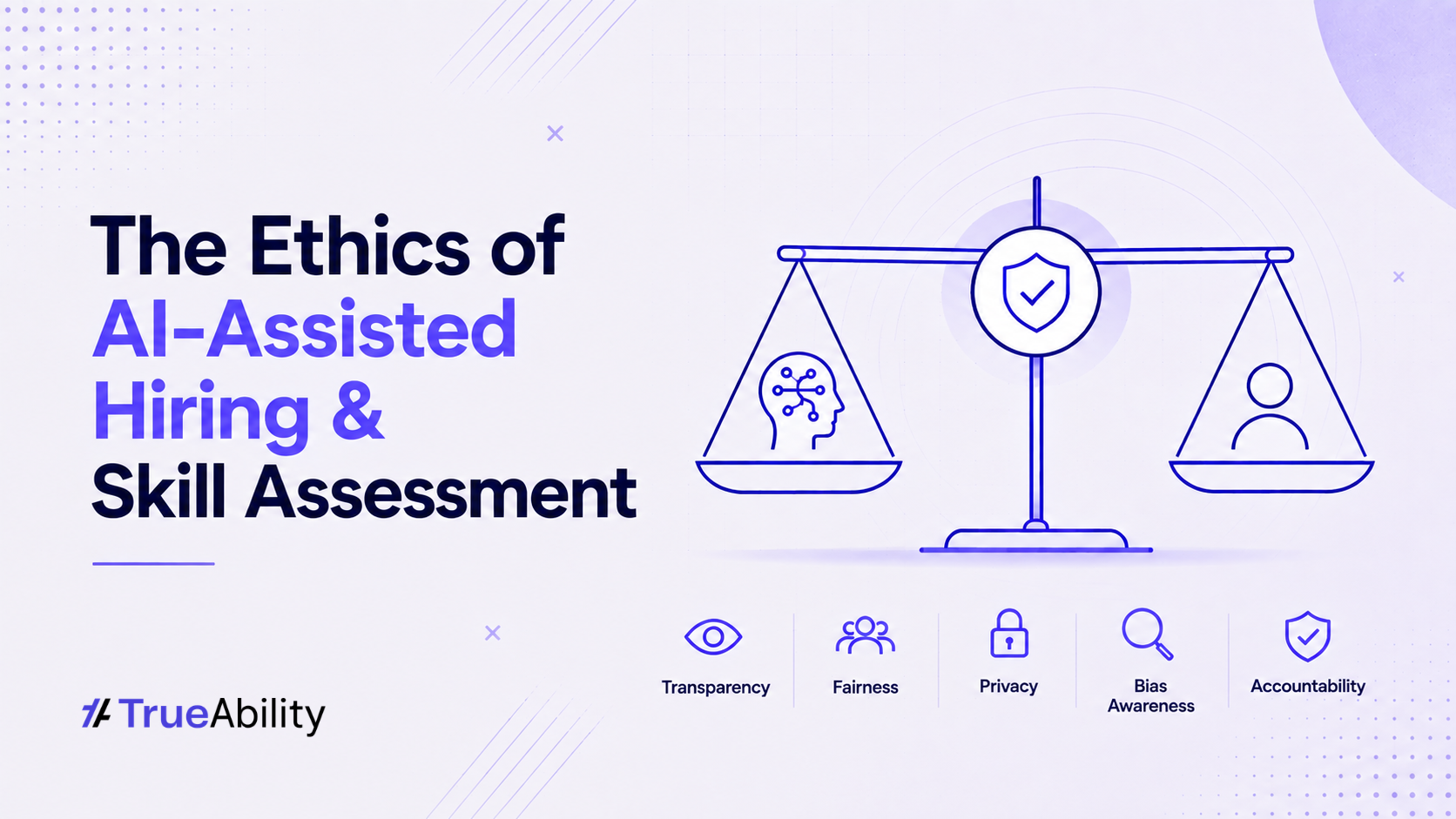
Artificial intelligence is changing how organizations find, screen, and evaluate talent.
Recruiting teams can use AI to review applications, identify potential matches, generate interview questions, analyze candidate information, and automate parts of the hiring process that once required hours of manual work.
The opportunity is significant. So is the responsibility.
When AI influences who advances in a hiring process, organizations have to ask more than whether the technology makes recruiting faster. They also need to ask whether the process is fair, transparent, job-relevant, and actually measuring what matters.
That distinction is particularly important in technical hiring.
AI may help analyze what a candidate says they know. But when the goal is determining whether someone can configure a system, troubleshoot an application, work in a cloud environment, or solve a real technical problem, employers still need reliable evidence of performance.
The future of hiring shouldn’t be about choosing between AI and human judgment. It should be about using AI responsibly while giving candidates better opportunities to prove what they can do.
What Is AI-Assisted Hiring?
AI-assisted hiring refers broadly to the use of artificial intelligence or algorithmic systems during recruiting and candidate evaluation.
Organizations may use AI to source candidates, match résumés to job descriptions, screen applications, communicate with applicants, generate interview questions, or evaluate candidate information.
These capabilities can make recruiting more efficient, especially when hiring teams are dealing with large applicant pools.
But automation doesn’t automatically make a hiring decision objective.
AI systems operate according to the models, data, inputs, criteria, and processes behind them. Those systems can introduce new risks or reproduce existing ones.
That makes responsible implementation especially important when AI moves from administrative support into candidate evaluation and employment decisions.
The Ethical Questions Behind AI in Hiring
The central ethical question isn’t simply whether employers should use AI.
It’s how AI is being used, what information it evaluates, and what evidence ultimately determines whether someone is qualified for a job.
Three areas deserve particular attention.
1. Bias Doesn’t Disappear With Automation
One of the promises associated with AI hiring is its potential to reduce human bias.
Technology can help organizations standardize certain processes and remove some irrelevant information from decisions. But AI itself isn’t automatically neutral.
A 2025 study published in PNAS Nexus tested several widely used large language models across approximately 361,000 résumé evaluations in which social identities were randomized. Researchers identified differences in scores associated with gender and race, including lower scores for Black male candidates with otherwise comparable qualifications.
The takeaway isn’t that every AI hiring tool is biased.
It’s that organizations shouldn’t assume automation equals fairness.
Employers need to understand what their systems evaluate, monitor outcomes for unintended effects, and validate that hiring tools are operating as intended.
2. Candidates Deserve Transparency
Imagine applying for a job without knowing that an algorithm helped determine whether your application moved forward.
Should candidates know when AI is materially involved in evaluating them?
Increasingly, regulators are addressing that question.
New York City’s Automated Employment Decision Tool law places requirements around certain automated employment decision tools. Covered employers and employment agencies must meet requirements related to bias audits, public information, and candidate or employee notices.
Illinois has also established disclosure and consent requirements for employers using artificial intelligence to analyze certain applicant video interviews.
Exact legal requirements vary by jurisdiction and use case, but the broader principle extends beyond compliance:
Candidates should understand how they are being evaluated.
3. AI Should Evaluate Job-Relevant Information
One of the most important questions organizations can ask about any hiring technology is surprisingly simple:
Does this actually tell us whether the candidate can perform the job?
A system can produce an impressive amount of candidate data without necessarily producing useful evidence of job readiness.
For technical positions, there’s an important difference between evaluating proxies for competence and evaluating competence itself.
Résumés, credentials, years of experience, and even knowledge-based questions can all provide useful information. But none necessarily demonstrates that someone can perform a particular task.
A performance-based skills assessment takes a different approach.
Instead of inferring ability from indirect signals, candidates complete job-relevant tasks in realistic environments.
A cloud engineer might configure infrastructure. A Linux administrator might diagnose and repair a system. A developer might debug an application.
The evaluation moves from:
“Does this person look qualified?”
to:
“Can this person perform the work?”
That distinction is becoming increasingly important as organizations adopt skills-based hiring strategies.
Skills-Based Hiring Requires Better Skills Assessment
Removing unnecessary degree requirements is often described as a major step toward skills-based hiring.
But changing a job description doesn’t necessarily change how hiring decisions are made.
Research from the Burning Glass Institute and Harvard Business School’s Project on Managing the Future of Work examined the gap between companies announcing skills-based hiring policies and their actual hiring practices. The researchers found that the resulting increase in opportunities for workers without degrees amounted to fewer than 1 in 700 hires during the period studied.
Organizations can say they hire for skills while continuing to rely on many of the same proxies they used before.
Real skills-based hiring requires a way to measure skills.
That’s where performance-based assessment becomes valuable.
Rather than asking candidates to describe how they would solve a problem, a performance-based assessment allows them to work through it.
That creates direct evidence employers can consider alongside interviews, experience, and other relevant information.
Standardization Matters
Ethical hiring doesn’t necessarily mean eliminating judgment. It means being intentional about where judgment enters the process.
Consider two candidates interviewing for the same technical role.
If one receives harder technical questions, more hints, additional time, or a substantially different evaluation environment, comparing their performance becomes difficult.
Structured assessments can reduce some of that variability by giving candidates equivalent environments, clearly defined tasks, consistent instructions, standardized time limits, and predetermined scoring criteria.
That doesn’t guarantee a perfectly fair process. No assessment should be treated as automatically free from bias simply because it’s standardized or automated.
But it creates a repeatable evaluation process that organizations can examine, validate, and improve.
AI Should Support Decisions — Not Become an Unquestioned Decision-Maker
The National Institute of Standards and Technology’s AI Risk Management Framework identifies characteristics associated with trustworthy AI, including validity and reliability, accountability and transparency, explainability, privacy, and fairness with harmful bias managed.
Those principles translate well to hiring.
Organizations using AI-assisted hiring should be able to answer questions like:
- What role does AI play in the hiring process?
- What candidate information does the system evaluate?
- Is that information relevant to successful job performance?
- Have outcomes been evaluated for potential adverse impact?
- Is there appropriate human oversight?
- Can candidates request accommodations or raise concerns?
- Is the assessment valid for the role being filled?
These questions turn AI governance from an abstract policy discussion into practical hiring design.
What About Adverse Impact?
AI hiring doesn’t exist outside established employment law.
In the United States, the Uniform Guidelines on Employee Selection Procedures address adverse impact in employee selection processes. The Guidelines also describe the well-known four-fifths rule as a rule of thumb: a selection rate for a group that is less than 80% of the selection rate for the group with the highest rate will generally be regarded as evidence of adverse impact.
That doesn’t mean every statistical difference automatically proves unlawful discrimination, nor does satisfying the four-fifths rule establish that a hiring process is fair.
It reinforces a broader point:
Organizations remain responsible for examining the outcomes of the selection procedures they use.
Adding AI doesn’t remove that responsibility.
A Better Model: AI + Performance Evidence + Human Oversight
Responsible AI-assisted hiring doesn’t require rejecting automation.
Instead, organizations can combine the strengths of technology with stronger evidence.
AI can assist with efficiency. It can reduce administrative work, organize information, support workflows, and help recruiters manage large candidate pools.
Performance-based assessment can provide evidence of skill. Candidates can demonstrate their abilities through realistic, job-relevant tasks.
Structured scoring can create consistency. Organizations can define what successful performance looks like before candidates begin.
Humans provide context and accountability. Hiring teams remain responsible for understanding the information being used and making appropriate employment decisions.
Together, these elements create something more valuable than automation alone:
an evidence-based hiring process.
How Performance-Based Assessment Fits Into Responsible AI Hiring
At TrueAbility, we believe technical skills are best validated through performance rather than assumed through credentials or knowledge alone.
For talent assessment, candidates can work inside live environments and complete tasks designed around the actual requirements of a role. Performance is evaluated against predefined outcomes, creating task-level evidence hiring teams can use alongside other information.
That distinction becomes even more important in an AI-assisted hiring environment.
AI can help candidates generate résumés, prepare interview responses, explain technical concepts, and optimize applications.
That means employers may increasingly need stronger signals of actual ability.
A candidate may have AI help them explain how to solve a problem.
A performance-based assessment can ask them to solve it.
The goal isn’t to eliminate AI from hiring. It’s to make sure technology doesn’t replace the evidence employers actually need.
Principles for Ethical AI-Assisted Hiring
Organizations introducing AI into recruiting and assessment should keep several principles in mind:
- Measure what matters. Evaluate skills and characteristics genuinely connected to the role.
- Prefer direct evidence where practical. Give candidates opportunities to demonstrate skills instead of relying exclusively on proxies.
- Monitor outcomes. Examine selection procedures for unintended disparities or adverse impact.
- Be transparent. Explain when automated technologies materially influence candidate evaluation.
- Keep humans accountable. AI can support decisions, but responsibility remains with the organization.
- Validate and revisit. Jobs, technologies, AI models, and candidate populations change. Assessment processes should evolve with them.
The Future of Hiring Is Evidence-Based
AI will almost certainly play a growing role in recruiting.
The more important question is what organizations choose to do with it.
Strong hiring systems won’t necessarily be those that automate the greatest number of decisions. They’ll be the ones that use technology to make evaluation more relevant, consistent, transparent, and evidence-driven.
For technical hiring, that means moving beyond asking whether a candidate appears qualified.
Give candidates the opportunity to prove it.
Because ultimately, one of the strongest hiring signals isn’t what an algorithm predicts someone might be able to do.
It’s what they can actually do.
Build a More Evidence-Based Skills Assessment Process
If your organization is moving toward skills-based hiring or reconsidering how candidates are evaluated in an AI-assisted recruiting environment, TrueAbility’s talent assessment platform helps organizations evaluate candidates through real-world, performance-based tasks.
Candidates work in live environments, complete job-relevant challenges, and can be evaluated against predefined outcomes.
Ready to see what performance-based hiring looks like? Explore TrueAbility’s talent assessment platform or talk with our team.